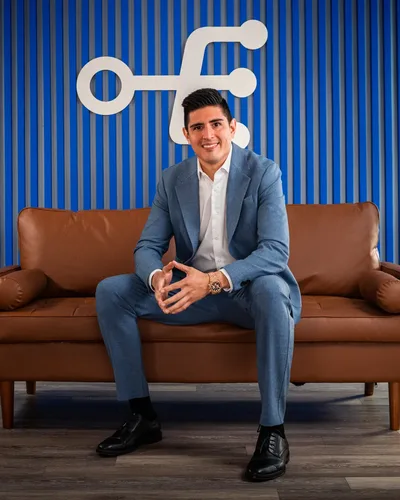
Rubio, Venezuela
I was born in Rubio, a small town in Táchira, on the border with Colombia. My family sold coffee. My dad took us to deliver it at the markets, and I was embarrassed when my classmates saw me.
At 16 I was already fixing computers and selling internet service. I earned a degree in computer science. My brother and I grew to three butcher shops.
Things were going well, but I couldn't show it. One day I was robbed at gunpoint. I thought: everything I built can disappear in a second. That's when I decided to leave.
One suitcase and $3,000
I planned the trip in two days. I left with my brother and some cousins, with a suitcase packed for five or six days. I didn't know when I'd see my parents again.
I had more back in Venezuela, but I made myself a rule: arrive with only $3,000. Going through immigration I almost cried. I told myself: "I'm not going back."
I arrived in Miami in 2016. In Miami I slept on a borrowed sofa for a few days, then rented a room. I didn't speak English. I worked one week in landscaping, moving sand with a shovel. Then I delivered pizzas for about two years.
I gave myself two years
Between deliveries I listened to audiobooks and studied how to sell online. It took me a year to read my first book, Rich Dad Poor Dad.
I knew I could get used to living paycheck to paycheck. So I set a deadline: two years to learn a skill. The day those two years were up, I quit. I didn't come to this country to stay small.
It didn't work the first time. I ran five projects at once and lost almost everything I had saved: about $30,000 in crypto and another $15,000 on Amazon. My most expensive lesson: focus on one thing.
Growing fast, then getting frozen
I got into ecommerce. I worked from my room, which was my bedroom and my office, with my cousins connected from Venezuela. I put a bottle of champagne in the fridge for the day we hit $100,000 in daily sales. And we got there.
Then the payment processor froze my money. About $230,000 was held, thousands of customers were waiting, and I owed my supplier. I got through it by being transparent: I paid him half of what I had and kept going. That blow was one of the reasons I moved into affiliates and leads.
From affiliate to Ecomfy Lead
First I was an affiliate, running traffic to other people's offers. Then I discovered leads: instead of buying, a person fills out a form because they want to be contacted.
I went to industry events in New York and Las Vegas understanding almost no English. I recorded the demos to watch them again and again. Then we built our own network from the ground up, with no investors.
That's how Ecomfy Lead LLC was born, registered in Florida on January 24, 2020. It's an affiliate network: we connect companies that need customers with affiliates who generate leads, calls and sales in the U.S. In 2024, Ecomfy Lead made the Inc. 5000 at #1533, with 337% growth over three years.
Today
- I run Ecomfy Lead from Miami, with a team that mostly works remotely from several countries.
- I'm building Ecomfy App, software that automatically distributes leads to insurance agents.
- I host a podcast called Carwin Martinez, where I talk with entrepreneurs about how they built what they have.
- On October 16, 2026, I gave the talk "The million-dollar lead business in the United States" at Feria Effix in Medellín.
- I'm married to Sharon and we have a son.
Three things I learned
- Focus on one thing. With five projects I lost almost everything. With one, I grew.
- Set a deadline. Without a date, you get comfortable.
- Be transparent when everything goes wrong. That's how I got through the worst moment of my business.
Where I'm speaking from
I share this only so you know where I'm speaking from.
- 8 years in marketing and advertising.
- $100M+ in sales and 10M+ leads across the companies I lead.
- Ecomfy Lead LLC: Inc. 5000 2024, #1533.
- Speaker at Feria Effix 2026, Medellín.
Where to start
If you want to understand how the U.S. lead business works, start with my free guide.